
escape
Books rock. I love reading. I can't imagine a life in which I couldn't escape this humdrum place to explore Middle Earth from Frodo's shoulder, or be blinded like Antonio Corelli by the intense sunlight of Cephallonia, or share in the elaborately witty banter of Eliza Bennet and her sisters. What a drab place it would be if I couldn't be challenged by the experiences and lives of other people.
So I thought I'd take this opportunity to share my experiences in literature with you, the browsing reader, in the hope that you might be illuminated and enriched by the jewels that I treasure, and avert your eyes from the turds littering our libraries that my eyes have been unfortunate enough to be violated by.
What better place to start than with my favourite book?
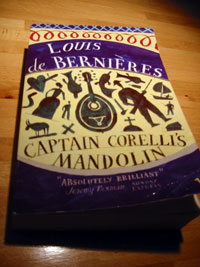
Captain Corelli's Mandolin, by Louis de Bernières.
It's hard not to gush about this one. Before I begin, a cautionary note: the recent film starring Penelope Cruz and the disastrously cast Nicholas Cage is a cloyingly sentimental and execrable confection that bears little resemblance to this elegantly crafted and beautiful story. It is a travesty.
But back to the original...
The novel is set on the unspoilt Greek island of Cephallonia, where life is an Arcadian idyll for its inhabitants. All this changes monumentally with the onset of the Second World War, and the existence of Pelagia and her father is irrevocably changed by the arrival of the Italian and German invaders. Nothing will ever be the same again.
The events of the occupation of Cephallonia, its liberation, and what follows, are told with heartrending simplicity; life is for these people as life is for us - full of tragedy and comedy in the least expected places. Above all, it is a human story, told in human terms. It is impossible to not empathise, to laugh and feel sad while reading this story.
I find Louis de Bernières' prose style indescribably poignant; his chapters are treasuries of well-turned phrases, concise and emotive, and while this inimitable style runs throughout, each character's ruminations and expressions are well-defined and peculiar to themselves alone - there is definite personality to each one.
It is to me quite miraculous and marvellous that such a poignant story can provoke such a strong emotional response without ever approaching bathos. I can't read this book without being on the verge of tears for the last twenty chapters, and I prefer to finish it somewhere alone where a full catharsis won't be embarrassing.
Whatever words I might choose to convey just how good this book is will always be woefully inadequate. Captain Corelli's Mandolin is not just a story, it's an overwhelming emotional experience, and if you don't think so, you have a heart of stone.
Buy it from Amazon.
Another great book by the same author: Birds Without Wings (hardback).
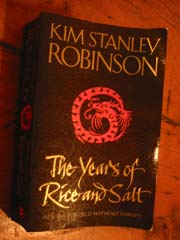
The Years of Rice and Salt, by Kim Stanley Robinson
Wally bought me this as a leaving gift in December 2003, and I really enjoyed it.
It's quite a bizarre proposition. The basic premise is that the plague that struck Europe in the 14th century actually wiped out all but a few pockets of Europeans, leaving the world a battleground between the remaining "civilisations" - Confucian China, Japan, the Indians, and Islam. It's a world where America (known as Yingzhou) is divided between the Chinese and Muslims, with the natives escaping to the interior. Against this oriental backdrop, a small group of characters are born, live their lives, and die, only to be reincarnated again and again through this alternative history, only remembering their past lives between death and rebirth.
You can't help getting dunked in Buddhist and Islamic ideologies, since each character struggles through a life permeated by religion. It's a pretty philosophical read, without you knowing it until the end. It forces you to think about death and what you're doing with your life. Am I going up the karmic ladder, doing what I can to improve life and society? Will I be rewarded by coming back as a better person, or punished and come back as a slug!?
So apart from being a really good read, with an addictive storyline tracing a history of might-have-beens, it leaves you thinking.
Buy it from Amazon.
Now & Then, by William Corlett
My flatmate, Pete, has lots of trash fiction, so it was with some trepidation that I selected this from his collection as my next read. Here's what I said back in November 2004, when I read it:
"Intricately textured, beautifully written and totally compelling" says one reviewer. The book is half in the past, half in the present - the narrative swinging from "now" to "then" and the story continuing in both streams throughout the passage of the book. It really is compelling, since the interlocking of past and present chapters makes for frequent cliffhangers.
The protagonist, Chris, is forced to relive his boyhood memories as his past catches up with him thirty years later; his life between times seems to have been a limbo, and only by reluctantly and uncomfortably digging up his tortured schooldays can he hope to achieve a resolution to the heartache that he's buried and denied (and yet cherished at the same time) all through his adulthood. I found myself both lingering and racing through the book - hanging on the bittersweet recollections of the past, and yet anxious to discover what followed.
The book's so well written, it was all too easy to put myself in Chris' shoes. We've all been lonely at some stage, haven't we? Here's a book to remind you how much people feel. Chris moves through wistful nostalgia, love and lust, frustration, ambivalence, deep-seated anger, hope and bitter disappointment, unrecognised pain; but throughout there persists a kind of numb sadness that Chris uses to keep loneliness at bay... and I've found it hard to forget he's just a character in a book. I've found it impossible to shake off the sadness this book has given me today.
Buy it from Amazon.
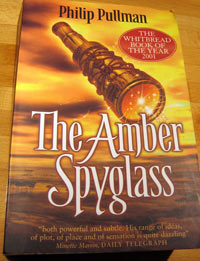
His Dark Materials (The Northern Lights, The Subtle Knife, and The Amber Spyglass), by Philip Pullman
These books are ones I'd seen in bookshops a while before I finally tried them, having heard from John and others how good they were.
The Northern Lights starts off in Oxford, but a parallel Oxford, in an England as you might expect to find in Sky Captain and the World of Tomorrow - modern but differently modern. You're never really sure at which point this England's history diverged from our own, but it's enough to produce a exotically different yet familiar backdrop to the book. In the world of Lyra, the 11 (or so) -year old girl who is the principal character, every human has a dæmon, an inseparable partner creature that reflects and balances his/her character. The concept of having a constant lifelong companion, confidant and comforter, is an appealing one, especially given the potential for its being soft and furry! But I digress...
Lyra and Will, a boy from our own England, are drawn into a battle between not good and evil (just for a change), but knowledge and ignorance - and freedom and subjugation. In Lyra's world, the enemy is the Church - part Calvinist, part Catholic in nature, and wholly mediaeval in its methods; in Will's, it is the nebulous and shadowy "authorities"; behind them is the Authority, God and his angels - and against them science, the enlightened, and the angels who rebelled against Heaven.
The books draw heavily on Milton's Paradise Lost and have been widely interpreted as anti-religion, and especially anti-Christian. There's no escaping that they are both of these, but they're a lot more subtle than the heavy-handed Christian allegory of C. S. Lewis' Chronicles of Narnia; but then I'm biased, so maybe I found these less invasive. The story is well-told, gripping, and intelligent. I thoroughly enjoyed them.
Buy all three from Amazon.